


The museum's second building, located at 101 Griboyedov Canal Embankment, known as the Albrecht-Alafuzov Mansion, was built in the late 18th century. A fine example of austere classicism, the mansion has largely retained its original appearance. Its historic interiors, dating back to the 19th century, have been largely preserved. Between the late 18th and the first half of the 19th centuries, the building housed a succession of government institutions, such as the Medical Ministry, the Department of the Customs and Taxes Ministry, the Forestry Institute, and the Merchant Shipping School.
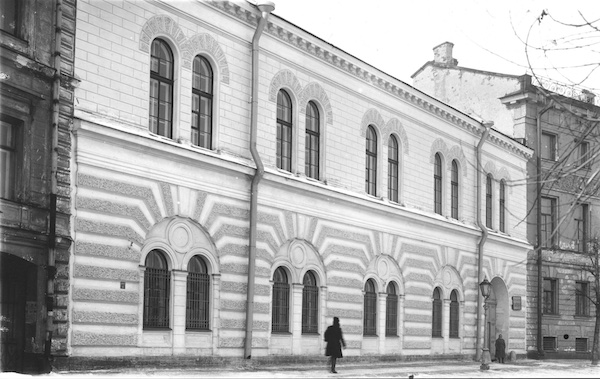
The building housed a police department until the end of the 19th century. It was then rebuilt and enlarged, first by the architect-engineer Anton Dominikovich Fialkovsky and later by the architect Aleksander Pavlovich Maksimov. After the architectural alterations a part of the construction facing the Griboyedov Canal was occupied by the police archive, and the other, facing the former Officers' Street (now Decembrists’ Street) accommodated the St Petersburg Criminal Investigation Police. Russia's first Criminal Police Museum was founded on this site in the early 20th century.

In 1917, the building endured hard times. The police archive was destroyed and the actual structure burned down. The part of the architectural complex overlooking Officers’ Street was redesigned and transformed into a communal house for proletarians. It is now a block of flats.
The building overlooking the Griboyedov Canal was renovated after the fire to accommodate in 1920 the Governorate Archive Bureau, which was transformed into the Leningrad Communist Party Archive in 1929. The Party Archive was evacuated to Chelyabinsk in the beginning of the Great Patriotic War. It was relocated to a new building in Smolny Street upon return to Leningrad in 1944. The printing house for cartographic products became a new owner of the building, which in turn gave way to the Archive of the City Court in 1998. In 2007, art occupied part of the architectural complex laden with grim memories. Maly zal (the small hall) of the Manege Central Exhibition Hall was opened here. Contemporary art has added energy of playful festival lightness to the space. Sharing the site proved to be inconvenient for both organisations. The archive initiated a long process of relocation, which ended in December 2015. As a result, the Museum of 20th–21st Century Art of St Petersburg (MASP) started developing the entire area, filling it with dynamic contemporary culture.
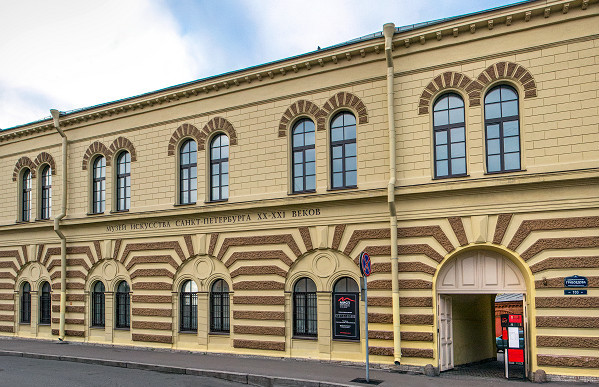

In 1856, the building passed from state ownership to a private individual – a retired major general and veteran of the 1812 Patriotic War, Karl Ivanovich Albrecht (1789–1859). At the same time, the mansion's most significant reconstruction was completed after design of the architect August Ivanovich Lange (1813–1881). The courtyard buildings were re-designed and some alterations were made to the façade details and interiors. From 1880 to 1917, the house was owned by the Alafuzov family of industrialists. The merchant Ivan Ivanovich Alafuzov (1837–1891) founded flax spinning, weaving, and tannery industries in Kazan in the 1860s. Alafuzov's factories produced overcoat and uniform cloth, thick woolen cloth, flannel, blankets, waterproof fabric, canvas, tarpaulin, and other products for the treasury. The company gained awards at the Russian and international exhibitions for the high quality of its products,. Expanding his business, Alafuzov opened a representative office in Petersburg and for that reason he purchased a mansion on the Ekaterininsky Canal. After Alafuzov's death, his heirs established the Joint-Stock Company and the Trade and Industrial Society for the Alafuzov Factories and Plants. The board of these companies, headed by Alafuzov's widow, Lidia Andreevna Alafuzova, was located in this very house. The Alafuzov family lived here until 1917. After the Revolution, the Alafuzov factories and plants were nationalised, and with that, the Alafuzov industrial and commercial empire ceased to exist.
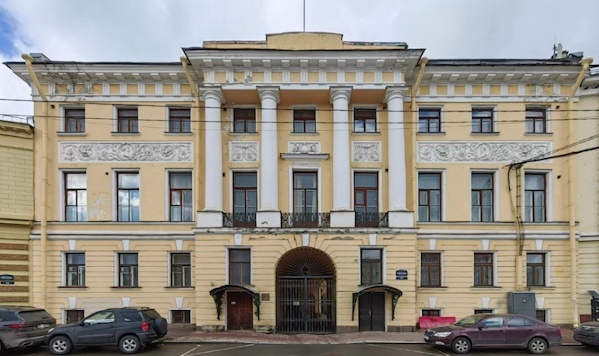
In the 1920s and 1930s, the former Alafuzov mansion housed a music college, a children's excursion and tourist station, a physical education college, and, after the war, the office of the Leningrad City Council Executive Committee. In the 1990s, the main building and courtyard outbuildings underwent major renovations and restoration. Until recently, the mansion housed the Lion Bridge Hotel. In 2024, the building was passed on to the Museum of 20th-21st Century Arts of St Petersburg.